





































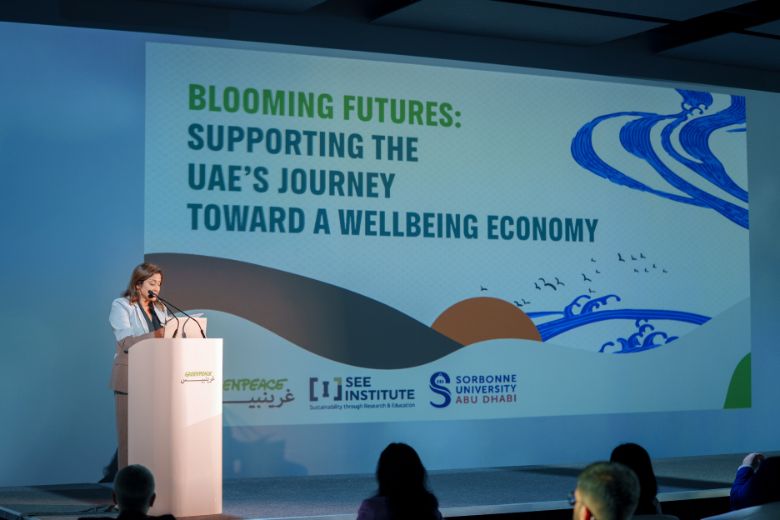
Greenpeace Middle East and North Africa, in collaboration with SEE Institute and Sorbonne University Abu Dhabi, launched the report “Blooming Futures: Supporting the UAE’s Journey Toward a Wellbeing Economy”. The report provides a practical framework for advancing a sustainable economy aligned with the UAE’s vision for long-term prosperity.
Written by Greenpeace MENA Wellbeing Economy Award-winning researchers Najla Almatrooshi and Nicole Weber, the report positions the UAE as a global leader in reimagining prosperity beyond GDP. It highlights a dual strategy of embracing biomimicry, learning from nature’s resilience, and adopting commons-based stewardship rooted in Emirati and Islamic heritage.
Strategic National Visions Support Wellbeing Economy
The report aligns with the UAE’s national visions, including We the UAE 2031, the UAE Centennial Plan 2071, and the UAE Net Zero by 2050 Strategic Initiative. These strategies support the development of a renewable, wellbeing-driven economy that balances growth with environmental sustainability.
It also lists practical steps for decision-makers, including sustainable financing tools such as welfare bonds for education, health, and social infrastructure, and green endowments for renewable energy and biodiversity protection.
Insights from Leaders
During the launch at The Sustainable City in Dubai, Ghiwa Nakat, Executive Director of Greenpeace MENA, said:
“The UAE has long been a place where bold visions take shape. In just a few decades, it has turned ambition into tangible outcomes placing wellbeing, quality of life, and sustainability at the heart of national planning. What we need now is the next leap: to learn from the most experienced teacher we have, nature. Through biomimicry, we can design as deserts conserve water, as mangroves protect shorelines, and as coral reefs build strength through cooperation. And through commons-based governance, we can manage what we share, water, air, soil, and knowledge, with care and accountability. When these approaches come together, we do not just decarbonise, we redesign. We move from extraction to regeneration, from short-term gain to long-term flourishing, shaping a regenerative economy that strengthens social cohesion, secures lasting prosperity, and sets a global model for wellbeing-led development.”
She added:
“We have already seen that ambitious policies can deliver both environmental and social transformation. The UAE has the cultural heritage, as well as the financial and institutional capacity, to lead this shift. By building on the important groundwork already laid through Vision 2031, Vision 2071, and the UAE Net Zero by 2050 initiatives, and by scaling biomimicry-inspired projects such as Al Bahr Towers, Masdar City, and The Sustainable City, the nation can set a model for the wider region and beyond.”
The Sustainable City as a Living Model
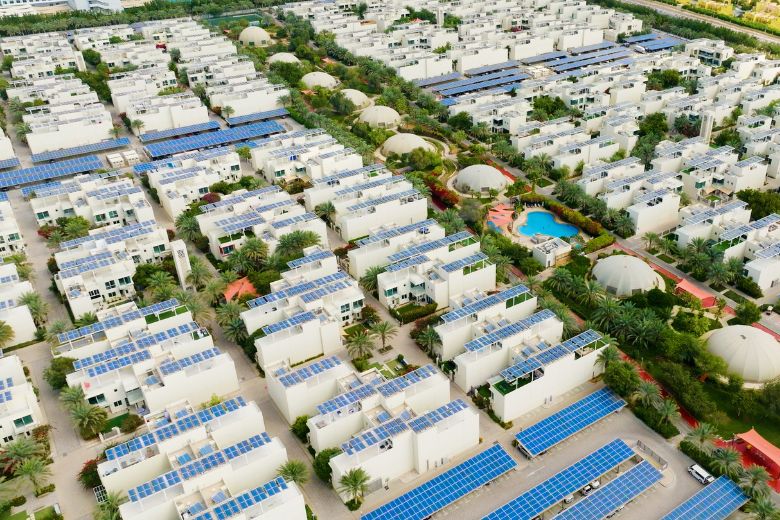
The report features The Sustainable City in Dubai, developed by SEE Holding, as a practical example of a wellbeing economy in action.
It is the first community in the region to rely on solar energy through over 40,000 solar panels with a total capacity of 10 MW, supporting net-zero emission urban living. The city encourages walking and shared electric mobility, reducing car dependence. Its agricultural zone features greenhouse biodomes, urban farms, and landscaped pathways, creating interactive spaces for community engagement.
The Sustainable City demonstrates how environmental efficiency, social integration, and economic sustainability can coexist, setting a benchmark for low-carbon urban development globally.
Integrating Academic Research and Policy
Dr Clio Chaveneau, head of SAFIR Institute, Sorbonne University Abu Dhabi, said:
“It has been an honour for Sorbonne University Abu Dhabi to contribute to this important work. We are proud to have trained and supported the two talented students whose research underpins the Blooming Futures report. This initiative exemplifies our commitment to advancing culturally grounded scholarship that bridges academic insight and real-world impact.”
Co-author Najla Al Matrooshi, Ajman Youth Council Member, added:
“Blooming Futures emerges from a belief that wellbeing is not a luxury of the few, but the collective rhythm of a society in harmony with its environment. This report is an invitation to rethink growth not as acceleration, but as cultivation, not as dominance, but as care. It reflects a generation that dares to imagine prosperity beyond extraction, grounded instead in empathy, knowledge, and coexistence. I hope it becomes both a mirror and a map, reflecting where we stand, and guiding us toward the futures we still have the power to shape.”
For more information please visit:
Further Reading:
- Shaping Pupil Wellbeing: A Holistic Approach at Brighton College Abu Dhabi
- Wellbeing in a Digital Age: Innovation and Authentic Intelligence
- Bringing Wellbeing to the Forefront of Education