






































From Internationally Mobile Expats to Young Athletes and Anxious Teens – Why More Gulf families are Choosing Minerva Virtual Academy.
On a weekday morning in Dubai, a group of parents and their children gathered for coffee, conversation, and an art meditation session led by a wellness practitioner. On the surface, it sounds like any number of parent community events happening across the city. What made this one different was that none of these families had ever met inside a school building. They had found each other and built something entirely online.
The event was Minerva Virtual Academy’s New Joiners Welcome Coffee Morning, hosted to bring together families who had enrolled in 2026 ahead of Term 3. What followed was two hours of introductions, an ice-breaker over breakfast, an immersive art meditation session, and by the end of it, new friendships. Harry Allen, Vice Principal, Middle East, Minerva Virtual Academy said,

“It was especially meaningful to meet and welcome our new joiners in person, giving new families the opportunity to connect early and feel part of the Minerva community from the outset. With more families joining across the region, it was inspiring to see our community come to life beyond the virtual classroom.”
The event captured something important about what MVA has spent years building and what an increasing number of Middle East families are actively seeking.
The Question that Changed the Conversation
When schools closed and learning moved home, some children struggled. That part of the story is well-known to many families. But something unexpected also happened; some children thrived. They were less anxious, less exhausted, more themselves. They stayed social in a way that felt more manageable. And their academic results held, or improved.
For parents who recognise that, MVA’s position is direct: those children were not thriving despite learning from home. They were thriving because the environment had changed, they were happier children. Harry Allen said,
“MVA was not a traditional school that adapted to online when circumstances required it. It was built from the ground up for this model of education. Every lesson format, every pastoral structure, every piece of technology we use was designed for this environment. That distinction matters.”

The Families Who are Choosing a Different Path
Upon looking closely at the families choosing Minerva across the Middle East, one thing becomes clear: these are not parents who have given up on education. They are parents who have outgrown the idea that it has to look the same for everyone.
The Internationally Mobile Family
Some families in the Middle East have relocated two, three, four times in as many years. Their children are bright and capable, but the academic disruption accumulates – curriculum gaps, friendships lost to school changes, a creeping sense that stability is something that happens to other families. The appeal of a school their child can stay with regardless of which city they wake up in next year is not a luxury.
PULL OUT- For these families, it is the most pragmatic option available. A British curriculum that travels with them, live lessons on Gulf Standard Time, and a mentor who knows their child by name whether they are in Dubai this term or Riyadh the next.
The Student Who Was Exhausted, Not Failing
Some children are not struggling academically. They are exhausted by the environment. The noise of a large campus. The social density of hundreds of students in corridors and canteens. The constant performance of being fine. These students are capable, sometimes highly so but the setting was working against them rather than for them. A calmer structure, with live lessons, a dedicated personal mentor, and a day that does not require performing for an audience of hundreds before a single lesson begins, is not a step back. For many of these students, it is the first time school has felt manageable.

The Parent Navigating A Specific Learning Profile
Parents of neurodivergent students, or those with ADHD, dyslexia, autism or anxiety, often describe years of advocating for their child within a system that could not flex enough without compromising academic ambition. The mainstream classroom was too rigid, too stimulating, or simply not designed around how their child processes information. The MVA model i.e. personalised support, reduced sensory pressure, known teachers, structured days gives these students a route to GCSEs and A Levels that does not require choosing between pastoral care and academic rigour.
The Athlete Or Performer With An Unconventional Schedule
A teenage tennis player training six days a week in Abu Dhabi. A dancer whose competition calendar makes a fixed school timetable functionally impossible. A student competing in motorsport across the region. These young people are not choosing between education and their ambitions. They are choosing a school that understands both are serious. MVA’s structure accommodates schedules that no traditional timetable could, without diminishing the academic pathway.
The Globally Mobile Family Who Wants Education To Match Their Life
Then there are families who are not running from anything. They are simply done with an education model that was not designed for how they live. No school run anchored to one postcode. No term-time travel restrictions. No assumption that family life looks the same for everyone. These are internationally minded parents who want a school that reflects the reality of raising children in the Middle East in 2026, where flexibility is not a workaround but an expectation.
What unites all of them is not a single pain point but a shared recognition: that the traditional campus model was designed around assumptions that simply do not apply to their lives.
What “Built For Online” Actually Means
It is worth being specific, because the phrase gets used loosely.
Minerva is DfE-accredited, which means it operates under the same regulatory standards as any British school in the UK. Its timetable runs on Gulf Standard Time – live lessons every day, taught by UK specialist teachers, at hours that work for families across the Middle East.
Every student is assigned a dedicated personal mentor, not as a pastoral add-on, but as a structural feature of how the school operates. Essentially, there is a third trusted adult in the family dynamic.
This is not a platform that delivers recorded content. It is not a self-directed learning service with optional check-ins. It is a school with the live interaction, the academic accountability, the community, and the qualification pathways that the word implies.
The GCSE and A Level structure is the same as it would be in any British secondary school. The difference is that the environment in which it is delivered has been designed to work for students who are better supported when they are not commuting to a campus, sitting in a hall of 200 for an assembly, and navigating the social complexity of a large site on top of their academic workload.
Community, Reimagined
One of the most common concerns parents raise when considering online schooling is the social question.
Will my child have friends?
Will they miss out on the things that happen beyond the classroom?
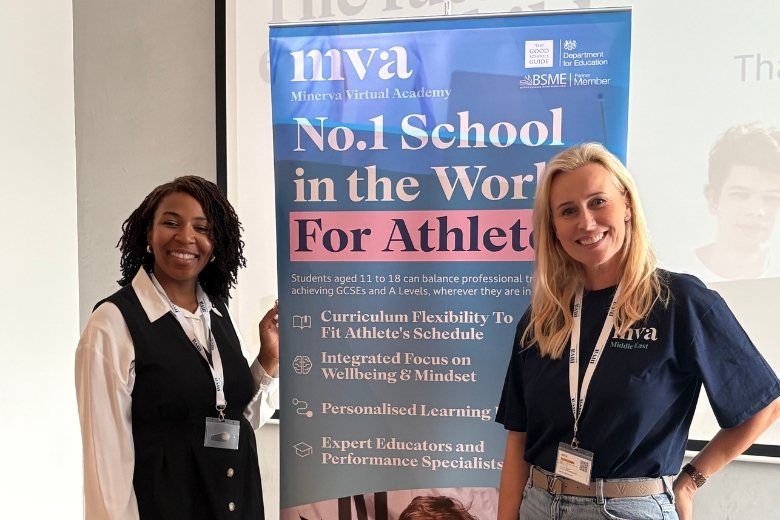
The MVA new joiners coffee morning was one example of how MVA answers that. Throughout each term, the school organises a programme of in-person community events and field trips across the Middle East – bringing together students and families who share something genuinely in common: a life that does not fit a standard school timetable. The connections that form tend to run deep precisely because of that shared experience. Students graduate with a peer group spanning more than 40 countries.
For Families In The Middle East
The Middle East’s internationally mobile population is large and growing. International school places are competitive and expensive in many cities. Families are increasingly asking whether the assumptions behind traditional schooling – fixed location, fixed timetable, social environments built for the average student are the right starting point.
For families who are relocating, or who have a child who quietly flourished when the world moved online, or who are simply looking for something that fits the life they actually live rather than the one a school calendar assumes they live, MVA is worth a conversation.
Families interested in finding out more can book a discovery call with the Minerva Middle East admissions team.
Minerva Virtual Academy is a DfE-accredited British online secondary school offering GCSE, IGCSE, A Level and BTEC pathways for students aged 11 to 18. It operates on Gulf Standard Time and has a dedicated regional community across the UAE, Saudi Arabia, Qatar, Kuwait, Bahrain and Oman.
Get the full picture of life at MVA – from how the lessons work to everything MVA offer’s beyond the classroom.
For more information visit
Further Reading
- Minerva Virtual Academy Expands to the Gulf – Offers Flexible British Education
- Not Just Another Platform. It’s a School.