






































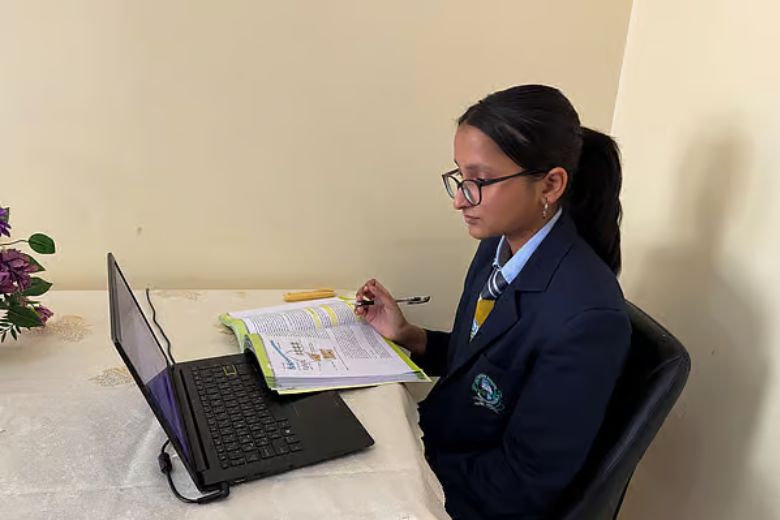
Thousands of senior students across the UAE are taking high-stakes examinations from home under strict digital supervision after schools rapidly transitioned back to distance learning.
The move follows renewed regional disruptions linked to the US-Israel-Iran conflict, which previously led to the cancellation of major board examinations including IGCSEs, A-Levels and IB final assessments.
After briefly resuming in-person learning on 20 April, schools once again shifted to remote education following emergency alerts issued across the UAE on 4 May, leaving institutions with limited time to organise traditional examinations for external boards.
Strict Online Monitoring Introduced During Assessments
Parents say schools have implemented rigorous digital monitoring systems to maintain exam integrity during remote assessments.
Arfarz Iqbal, parent of a Year 11 student, explained that schools are now conducting internal assessments to build academic portfolios for UK examination boards.
“Last week, these exams were conducted on campus. However, with the shift to distance learning, they are now being held online. Students must keep their cameras on at all times, with the camera positioned to clearly show their faces, hands, and the paper they are writing on. Teachers can randomly ask students to scan the room with their laptops, while the entire session is recorded. Students are not allowed to keep headphones or phones nearby.”
Schools Rely on Digital Tools to Maintain Exam Credibility
Nord Anglia International School, Dubai, said established online systems helped ease the transition to remote assessments.
Maggie Perkins explained that digital assessment platform Exam.net has been central to maintaining standards.
“Ensuring exam integrity in a distance learning setting has been a key priority. We’re using Exam.net. This means both staff and students have already been well-trained. This is supported by a robust online assessment policy, enabling us to minimise malpractice and maintain confidence in the validity of outcomes submitted to external exam boards.”
She said advanced planning allowed schools to move online quickly.
“Logistically, we’ve not faced any significant challenges. Early planning and prior training have meant we’ve been able to transition all Year 11 and Year 13 A-level students online quickly and smoothly.”
Schools Adapt Rapidly to Remote Assessments
The Apple International School also highlighted the importance of coordinated planning and supervision measures.
Jinto Sebastian said:
“Ensuring the integrity and credibility of assessments within a distance learning environment remains a key priority for the school. Senior students are supervised through scheduled invigilation measures, real-time monitoring, and controlled assessment practices to minimise the possibility of malpractice. The transition to remote high-stakes assessments required immediate alignment. Key challenges included adapting assessment systems within a limited timeframe. These were addressed through collaborative planning and clear communication with all stakeholders.”
Families Balance Exam Pressure and Home Disruptions
While schools emphasise preparation and digital safeguards, families say maintaining ideal exam conditions at home can still be difficult.
Maria Santos, a Filipino parent, said her daughter’s school is also conducting online internal assessments for submission to UK examination boards.
“The assessments have now moved online, and students must remain on camera throughout. However, with everyone at home, maintaining a quiet environment throughout the entire exam duration can be difficult at times. Once the exam is over, students have to quickly scan and upload their answer sheets to the school’s system. I would say, despite the small hurdles, the systems in place offer a sense of continuity during uncertain times, ensuring students can progress academically.”
For more information please visit
Further Reading:
- UAE Schools Prepare for CBSE Third Language Deadline for Grade 6
- MVA Middle East Welcomes New Students and Families at Dubai Coffee Morning