



































Introduction to Esports
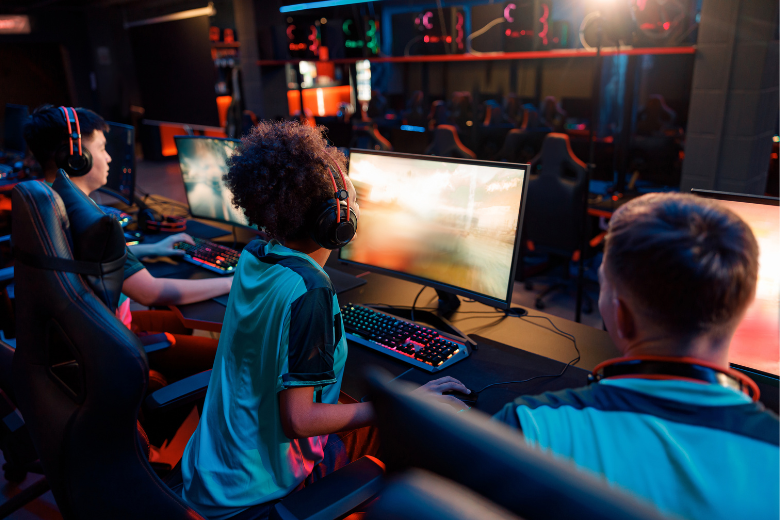
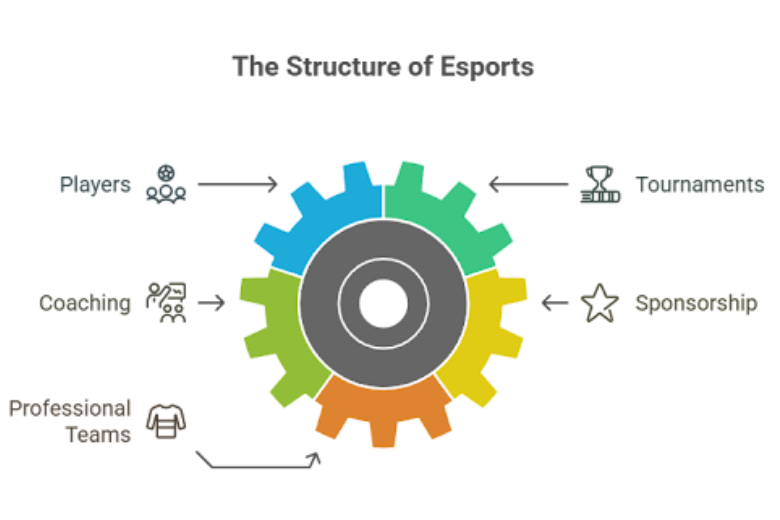
Esports (short for “electronic sports”) refers to competitive, organised video gaming. Players, either individually or in teams, compete against each other at local, national and international tournaments. Unlike casual gaming, which is done mainly for personal enjoyment, esports is structured more like traditional sports – with leagues, tournaments, coaching, sponsorship and professional teams.
History of Esports
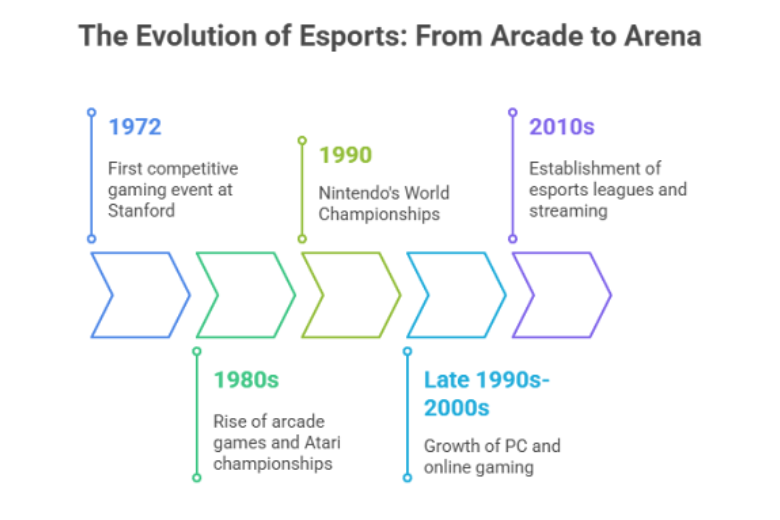
One of the first recorded competitive gaming events took place in 1972 at Stanford University, where students competed in a game called Spacewar! for a year’s subscription to Rolling Stone magazine. The scene gained momentum in the 1980s with the rise of arcade games like Pac-Man and Donkey Kong and the launch of competitions such as the Video Game World Championships hosted by Atari.
In 1990, Nintendo’s World Championships brought further attention to competitive gaming, but it was the growth of PC and online gaming in the late 1990s and early 2000s that truly transformed esports. Esports popular games such as StarCraft, Counter-Strike and Quake started international tournaments, while the rise of broadband internet enabled players to compete globally.
By the 2010s, the introduction of live streaming platforms like Twitch and the professionalisation of leagues for games such as League of Legends and Dota 2 firmly established esports as a major form of entertainment, attracting millions of viewers and substantial prize pools.
Key Differences: Esports vs. Casual Gaming
| Components | Casual Gaming | Esports |
| Purpose | Fun, relaxation, personal challenge | Competitive, professional recognition, prizes |
| Organisation | Unstructured or light structure | Highly organised tournaments and leagues |
| Skill Level | Varies widely | Extremely high often world-class |
| Time Commitment | Flexible | Full-time training and practice required |
| Monetisation | Rare | Salaries, sponsorships, prize money |
The Growth of the Esports Industry
Esports is no longer a niche hobby – it’s a global, multi-billion-dollar industry.
with millions of fans tuning in online and in sold-out arenas to watch teams compete. Key contributors to growth include:
Key contributors to growth include:
- Streaming platforms like Twitch, YouTube Gaming and Kick.
- Game publishers investing in esports ecosystems (e.g., Riot Games with League of Legends).
- Corporate sponsorship from leading brands such as Red Bull, Intel and Mercedes-Benz, this has included the provision of merchandise, hydration products and even professional esports gaming equipment.
A recent example of this growth is Fnatic announcing Red Bull as its Official Energy Drink Partner in January 2025. The collaboration highlights how global brands are investing in esports partnerships to amplify content, boost fan engagement, and push the boundaries of competitive gaming worldwide.
Major Esports Titles Include:
A major esports title refers to a video game that has gained significant prominence and competitiveness within the global esports landscape. These games are typically the focus of large-scale tournaments, often featuring substantial prize pools, professional teams and widespread fan engagement. Such titles support thriving professional scenes and often set industry standards, serving as benchmarks for other games aiming to establish themselves in the competitive gaming world.
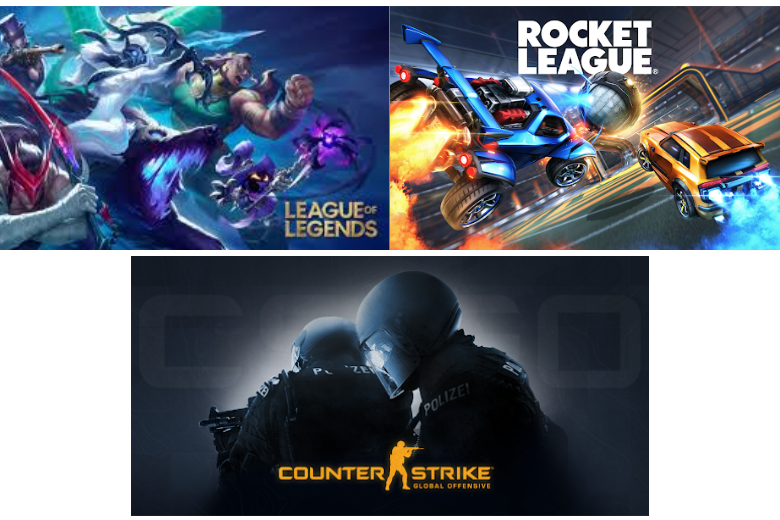
Major esports titles include:
- League of Legends
- Counter-Strike Global Offensive
- Dota 2
- Valorant
- Rocket League
- Overwatch 2
- Fortnite
Each of these titles belong to an esports genre.
The Different Genres of Esports Explained
Esports genres refer to the different categories of competitive video games played at a professional level. Each genre offers its own style of gameplay, rules and strategies, attracting varied audiences and types of players. These genres help define the structure of esports competitions and shape the skills required for success in each game.
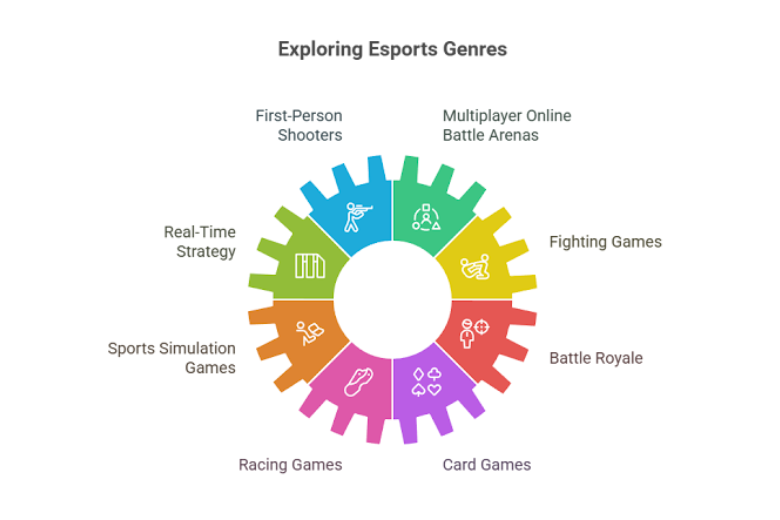
- First-Person Shooters (FPS):
These games focus on gun-based combat from a first-person perspective. Players rely on aim, reflexes and strategy. Popular formats include team-based objective modes where there is an objective for teams alongside team elimination. One of the most popular games in this genre is Counter-Strike. - Multiplayer Online Battle Arenas (MOBA)
MOBA games involve two teams competing to destroy each other’s base, with players controlling unique characters that have specific roles. Team coordination and strategy are key. Matches are typically played on fixed maps with defined lanes. One of the most popular games in this genre is League of Legends. - Real-Time Strategy (RTS):
In RTS games, players control entire armies or factions, building bases, gathering resources and deploying units in real time. They require strategic thinking, multitasking and precise timing. One of the most popular games in this genre is Starcraft II. - Fighting Games:
These are one-on-one combat games where players use combos, blocks and counters to outplay their opponents. Skill, timing and character knowledge are vital. They’re typically fast-paced and feature a steep learning curve. One of the most popular games in this genre is Street Fighter. - Sports Simulation Games:
These replicate real-world sports like football, basketball, or racing. Competitions often mirror actual sports leagues, and they’re popular with fans of the corresponding real-life sports.One of the most popular games in this genre is EA FC (formerly called Fifa) - Battle Royale:
A sub-genre of first person shooters, battle royale games involve large numbers of players competing until only one remains. Survival, scavenging and strategic positioning are key elements. One of the most popular games in this genre is Fortnite. - Racing Games:
These titles focus on speed, control and track mastery. Esports competitions include both realistic simulators and arcade-style racers, often featuring time trials, head-to-head races and global tournaments. One of the most popular games in this genre is Grand Turismo 7. - Card Games (CCG/TCG):
Competitive card games involve building and refining decks to face off in strategic, turn-based matches. They demand foresight, resource management and adaptability. Professional circuits include global tournaments, seasonal popular trends and strong online communities. One of the most popular games in this genre is Hearthstone.
Key Components of the Esports World
Professional esports organisations recruit players, secure sponsorship and build their brands. Many have training facilities, coaching staff and marketing departments. Their success relies on competitive results and strong fan engagement.
Examples of Well-Known Teams:
|
|
Fnatic – Based in the UK, Fnatic is one of the oldest and most successful esports organisations, known for its achievements in League of Legends, Counter-Strike and VALORANT. |
|
|
G2 Esports – A European powerhouse with a playful brand and serious results, G2 competes at the highest level in games like League of Legends, CS:GO and Rainbow Six Siege. |
|
|
Team Liquid – A globally renowned team with strong roots in North America and Europe, Team Liquid fields competitive rosters in numerous titles, including Dota 2, CS:GO and StarCraft II. |
|
|
T1 – Based in South Korea, T1 is legendary in League of Legends and home to one of the most famous esports players in history, Faker. The team symbolises dominance and consistency. |
|
|
100 Thieves – An American organisation that blends esports with lifestyle branding, streetwear and content creation. They’re known for their presence in Call of Duty, VALORANT, and League of Legends. |
|
|
FaZe Clan – Originally founded as a group known for their creative and skilled elimination of players known as ‘Trickshot’ clips on YouTube, FaZe Clan has grown into a cultural icon in gaming and esports. Competing in titles like Call of Duty, CS:GO and Fortnite, they’re also known for their collaborations in the fashion world and with famous celebrities. |


Examples of Famous Players:
- Faker (T1 – League of Legends) — often called the greatest League of Legends player of all time.
- s1mple (Natus Vincere – Counter-Strike 2) — widely considered one of the best FPS players ever.
- Bugha (Fortnite) — winner of the 2019 Fortnite World Cup.
- TenZ (Sentinels – Valorant) — one of Valorant’s most popular and skilled players.
- M0NESY (G2 Esports – Counter-Strike 2) — a young star known for his sharp aim and smart plays.
Game Publishers
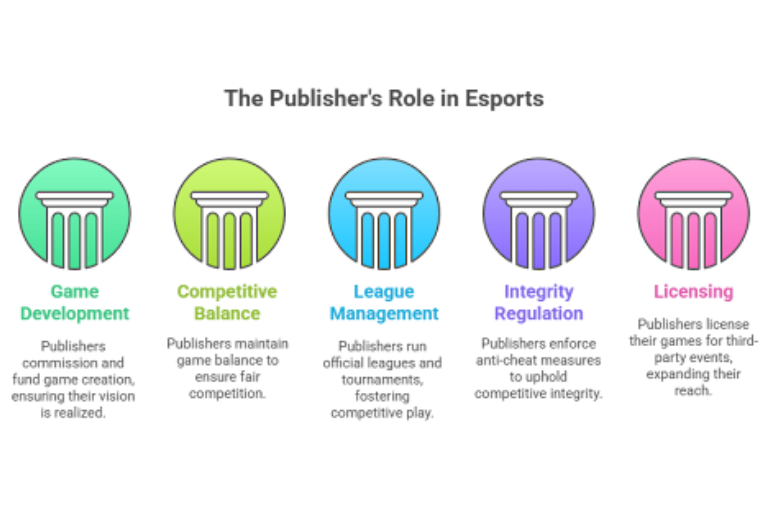
Game publishers play a pivotal role in the esports ecosystem. They commission development studios to create games based on their vision and typically provide the initial funding required for production. As the holders of the intellectual property (IP), publishers maintain control over how their titles are used within competitive environments. Their responsibilities often include:
- Developing and balancing the game for fair competition
- Running official leagues and tournaments for their game titles
- Regulating competitive integrity (e.g. anti-cheat measures)
- Licensing the game for third-party events
Some publishers opt for a centralised model, restricting competitive play to their own organised tournaments – such as franchised leagues, while others adopt a more open approach, allowing their titles to be featured in esports competitions globally.
Tournament Organisers
These organisations host and manage events, from logistics and rule enforcement to marketing and broadcasting. Some are independent, while others are publisher-affiliated. Well-known organisers include ESL, BLAST and DreamHack.
From local cups to world championships, events are often streamed live to global audiences. Some famous tournaments include:
- The International (Dota 2): Prize Pool 2024 $2,602,164
- League of Legends World Championship: Prize Pool 2024 $1,000,000
- Valorant Champions Tour (VCT): Prize Pool 2024 $1,000,000
- Esports World Cup : Prize Pool 2025 $70,000,000
Esports Tournaments in UAE
Dubai now hosts international qualifiers, regional finals and school-level competitions. Popular events include:
- Esports World Cup qualifiers held in Dubai venues.
- University-level esports challenges in Dubai Knowledge Park.
- Local tournaments in Valorant and Fortnite.
- Abu Dhabi has hosted the Blast Premier World Finals, a global tournament.
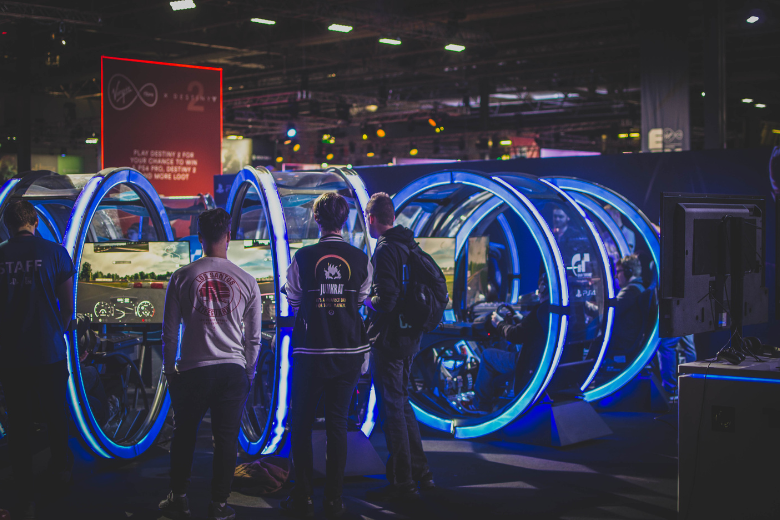
These events show that what is esports is no longer just a global phenomenon – it has a firm position in Dubai’s entertainment calendar.
Sponsors and Brands
Some brands (e.g. energy drinks, telecoms, finance) and gaming-related companies (e.g. hardware manufacturers) invest in esports for exposure to a young, tech-savvy audience. Sponsorships help fund players, teams and events.
Media and Streaming Platforms
Platforms like Twitch, YouTube and Kick are essential for content distribution. They host live broadcasts and videos of esports tournaments (on demand) and often secure the exclusive rights to major esport events, making them major revenue drivers and audience hubs. These platforms are seen as key elements in the rapid rise of esports globally with revenue and viewership.
Governing Bodies of Esports
The esports industry, though relatively young compared to traditional sports, has developed a number of governing bodies to bring structure, standardisation and legitimacy to competitive gaming on a global scale. Unlike most conventional sports, esports does not have a single overarching authority. Instead, governance is fragmented across various organisations, each with different scopes of influence depending on the region, game title or tournament circuit.
One of the most prominent global entities is the International Esports Federation (IESF), founded in 2008. Based in South Korea, the IESF aims to have esports recognised as a legitimate sport worldwide. It works with national federations, organises international tournaments and promotes standards for fair play and athlete welfare.
Another key player is the Global Esports Federation (GEF), launched in 2019 with support from various stakeholders, including national Olympic committees. The GEF seeks to build a more unified structure within the esports ecosystem, advocating for education, integrity and innovation in the space.
On a national level, countries have established their own esports federations or associations. For example, the British Esports Federation (British Esports) serves as the UK’s not-for-profit body for promoting grassroots esports, supporting schools and colleges and advocating for player development and safeguarding.
In addition to these organisations, individual game publishers often serve as the de facto governing bodies for their titles. Companies such as Riot Games, Blizzard Entertainment, and Valve Corporation create and enforce competitive rules, oversee professional leagues and manage disciplinary actions within their respective ecosystems.
While the diversity of governing bodies allows for flexibility and innovation, it also presents challenges around standardisation, jurisdiction and athlete representation. As esports continues to mature, greater collaboration and clearer regulatory frameworks are likely to emerge, potentially leading to more cohesive global governance in the future.
Fans and Community
Esports communities are passionate and active, gathering on online forums like Reddit, Discord servers and at live viewing parties. These platforms act as central hubs for fans and players to connect, share insights and build a sense of belonging around their favourite games and teams.
Reddit is a large online forum made up of thousands of “subreddits” – dedicated communities focused on specific topics. In esports, subreddits like ‘r/leagueoflegends’ or ‘r/Valorant’ see daily discussions about matches, updates, team news and player stats, often featuring in-depth analysis and humour from fans.
Discord, on the other hand, is a communication platform designed for creating invite-only servers where users can chat via text, voice, or video. It’s commonly used by esports teams, tournament organisers and fan groups to coordinate matches, stream content and socialise in real time.
Common Myth about Esports
Myth: “Esports is just a waste of time – It can’t become a real career”
Reality: Esports is now a multi-billion-dollar global industry, offering a wide range of career opportunities beyond just playing professionally. Roles include coaching, event management, marketing, broadcasting, journalism, content creation, game development, and more.
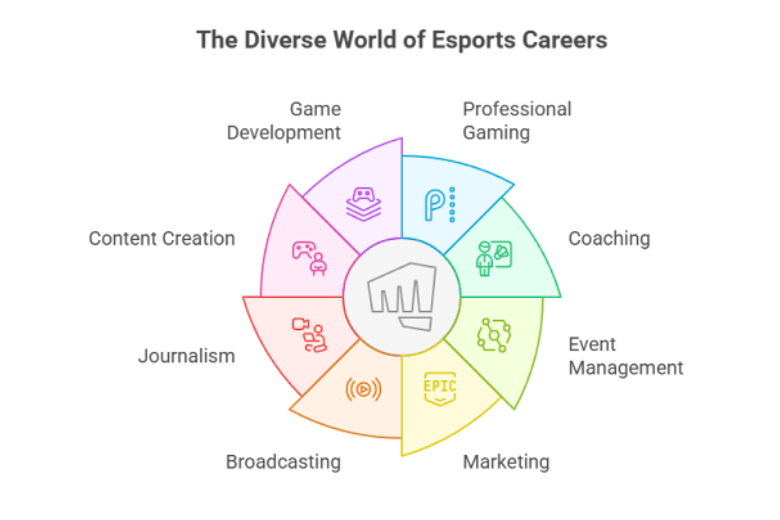
Career Opportunities in Esports
You don’t have to be a top-tier player to work in esports! The industry is made up of a wide range of careers:
| Career Type | Example Roles |
| Team and player support | Coach, Analyst |
| Broadcast and Media | Caster (Commentator), Host, Producer, Content Creator |
| Management and Event Operations | Team Manager, Agent, Event Organiser |
| Technology and Design | Game Developer, Stream Technician, UI/UX Designer |
| Business and Marketing | Sponsorship Manager, Brand Strategist, Social Media Manager |
| Health and Wellness | Sports Psychologist, Physiotherapist, Nutritionist |
| Education & Training | Esports Educator, Curriculum Developer, Esports Tutor and Workshop Facilitator |
| Legal & Finance | Esports Lawyer, Contract Specialist, Financial Advisor and Compliance Officer |
| Community & Engagement | Community Manager, Discord Moderator, Fan Engagement Officer and Community Outreach Specialist |
| Infrastructure & Support | IT Support, Hardware Specialist, Network Engineer and Equipment Manager |
EStars and the Future of Esports in the UAE
When asking what is esports, it is not just about the tournaments and the games – it is also about the education and opportunities that support future generations. This is where EStars plays a central role in UAE’s esports ecosystem.
EStars is an award-winning global leader in the esports industry, providing innovative solutions for integrating esports into education and for delivering futuristic room designs and builds.
EStars has been deeply involved in every layer of the industry, from competitive play to technology and curriculum design. In the UAE, EStars bridges the gap between gaming enthusiasm and professional development by offering accredited qualifications tailored for students.
- Level 1 Certificate in Esports (endorsed by NOCN) introduces students to the foundations of the industry, providing an accessible starting point.
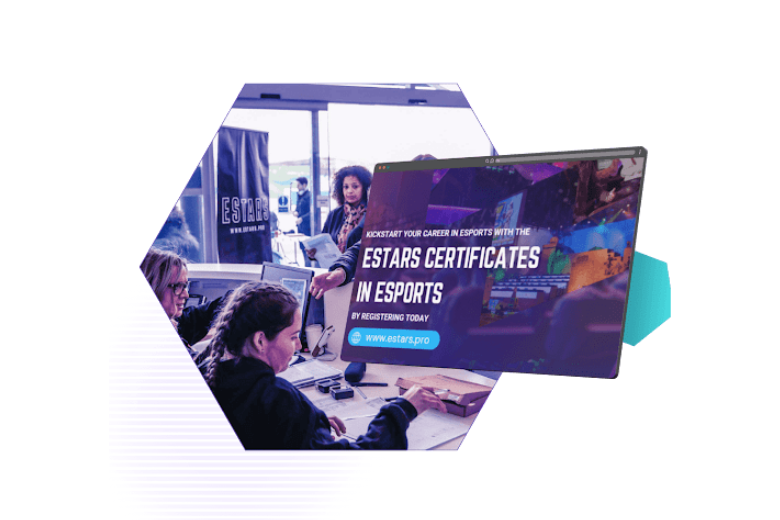
- Pearson BTEC in Esports (Level 2) goes deeper, covering the business, event management and digital skills required to thrive in this growing sector. It is equivalent to a GCSE and offers clear progression pathways into careers.
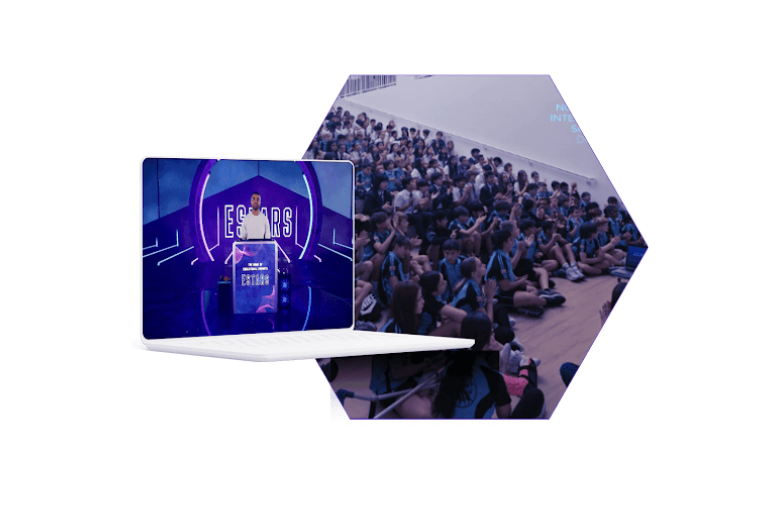
By integrating esports into education, EStars ensures that students across the UAE are not only passionate players but also equipped with professional skills. This also aligns with Dubai’s vision of becoming a regional hub for innovation, digital careers and future-ready learning.
Final Thoughts
So, what is esports? It is a fast-growing global industry, an exciting career pathway and a cultural phenomenon that has taken root in Dubai and is spreading across the UAE. With the city hosting tournaments, building communities and embracing esports in schools, the future is full of opportunity.
EStars stands at the heart of this transformation. By combining international expertise with accredited qualifications, EStars is shaping the future of esports in UAE, turning curiosity into careers and passion into lifelong skills.
EStars’ strength also lies in the credibility of its qualifications. The organisation is officially accredited by NOCN and Pearson, two of the most respected awarding bodies in the United Kingdom and internationally.
- The NOCN Level 1 Certificate in Esports provides students with an essential introduction to the industry, covering its structure, careers, and digital skills. It is designed to open doors for learners of all abilities and offers a practical foundation for further study.
- The Pearson BTEC in Esports (Level 2) delivers a deeper exploration into the business, management, and operational side of competitive gaming. Equivalent to one GCSE, it equips students with transferable skills that extend beyond gaming, including teamwork, communication, and digital literacy.
Through these accredited pathways, EStars ensures that esports education in the UAE is not just innovative but also internationally recognised. Students gain qualifications that are respected by employers and universities, giving them tangible value for their future careers.
Shape Your Future in Esports Today
Don’t just play the game! Build your career in it. With EStars’ internationally accredited qualifications, you can turn your passion for gaming into recognised skills and future-ready opportunities.
Further Reading:
- What If Your Classroom Helped You Breathe Easier? Step Inside The UAE’s Most Mindful Classrooms With ESTARS
- Esports Isn’t the Future — It’s Now. NAS Dubai Students Prove It with EStars BTEC
- EStars Inspires the Next Generation of Esports Enthusiasts
- THE EStars CLASSROOM OF THE FUTURE
- Step Into the World of Esports With The EStars Certificates
- Powering Esports in the UAE – How EStars is Revolutionising Talent Acquisition in Esports
- Levelling Up Learning: Esports Education in UAE Comes Alive at Yas Creative Hub
FAQs
Esports is competitive video gaming with teams, coaches, leagues and events. Matches are streamed to fans online and in arenas.
Yes. Roles include coaching, casting, event ops, content, tech, health and ed. Many paths do not require elite play.
Popular titles include League of Legends, Counter Strike 2, Dota 2, Valorant, Rocket League, Fortnite and EA FC.
Schools can integrate esports by offering curriculum-based courses, hosting after-school clubs, building immersive spaces, organising educational trips and running tournaments.
Learners can study EStars programmes that include the NOCN Level 1 Certificate in Esports and the Pearson BTEC in Esports Level 2, an award equal to one GCSE.
EStars delivers accredited learning with the NOCN Level 1 Certificate and the Pearson BTEC in Esports Level 2. Learn more at estars.pro.