



































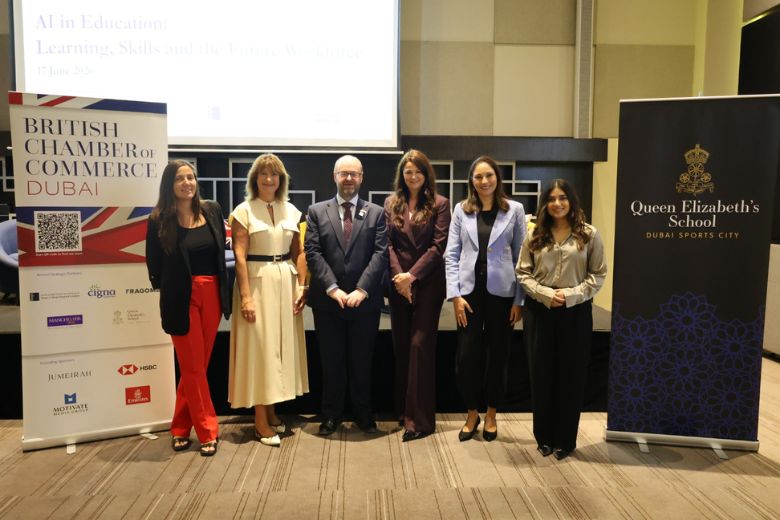
Inside the British Chamber of Commerce Dubai’s Business Briefing, sponsored by Queen Elizabeth’s School Dubai, Sports City
One year ago, the UAE announced plans to embed Artificial Intelligence into education as part of its wider ambition to become a global AI leader by 2031. Twelve months on, the British Chamber of Commerce Dubai (BCCD) returned to the question that started the conversation: How should schools embrace AI while protecting the very human experience of learning?
Education leaders, parents, business professionals and technology innovators gathered at voco Dubai for the Chamber’s AI in Education Business Briefing to find out.
Five Key Questions Raised During the Event
- Will AI break schooling?
- Can AI help solve the challenge of personalised learning?
- How do schools prevent cognitive debt?
- What skills will employers value most in an AI-driven economy?
- How can schools embrace technology without losing the human experience of learning?
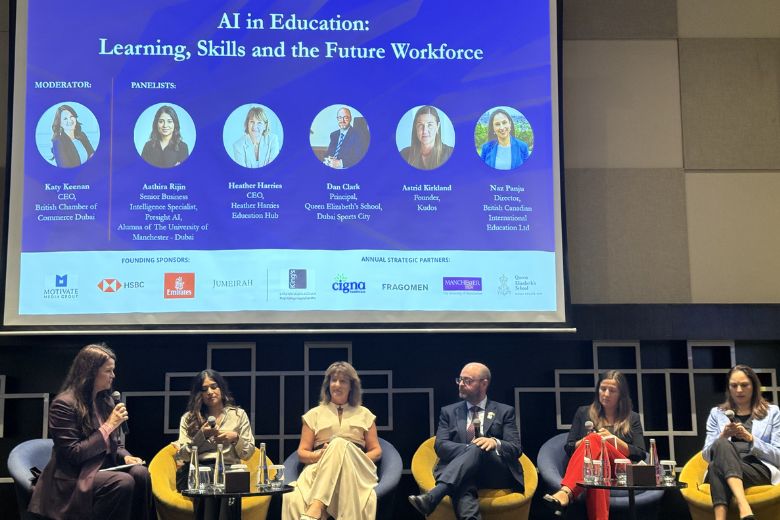
Will AI break schooling?
That was the question Dan Clark, Principal at Queen Elizabeth School opened with, and it set the tone for the morning.
The numbers make the question harder to dodge. 86 percent of young people have already used generative AI, by the panel’s own figures, most of them well before any school had a policy in place to guide them. Exam boards are scrambling to catch up. Assessments have been disrupted almost overnight. Students adopted the technology before schools had the expertise, or in many cases the appetite, to respond.
The conversation moved quickly past the technology itself and landed on something more pressing: the skills, behaviours and human qualities young people will need to thrive in an AI-driven world.
History suggests every generation faces a major technological disruption. Schools have never known exactly what the future will demand of their students, yet the most successful ones have always prepared young people by focusing on transferable skills rather than fixed knowledge.
“Every generation has had a grand disruption to manage.” – Dan Clark
For Clark, the real question isn’t whether AI exists. It’s how schools choose to respond to it.
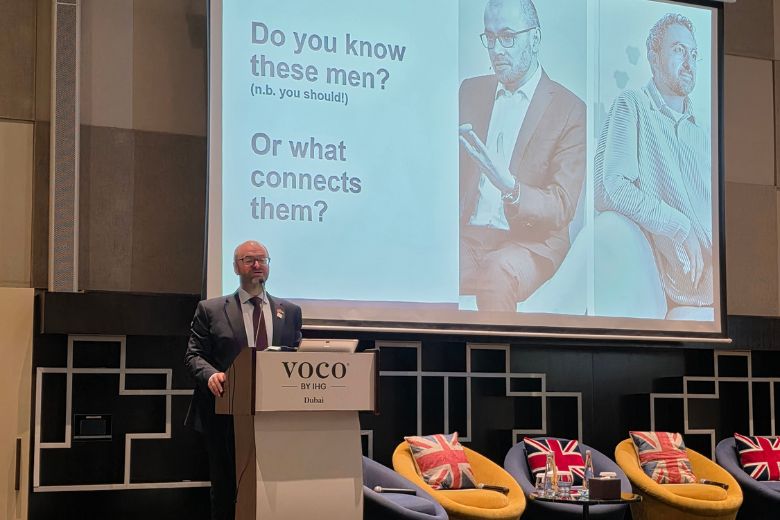
The Paradox: AI May Make Schools More Human
Most fears about AI in schools start from the same place: that a machine doing more means a teacher doing less, and eventually mattering less. Dan Clark’s panel spent a good part of the morning making the opposite case, and made it stick. However, onee of the strongest ideas to emerge from the briefing was a paradox.
“AI may make schools more human.” – Dan Clark
The fear is that technology will edge out teachers. The panel argued the opposite may prove true. If AI takes on repetitive administrative work, generates resources, supports planning and assists with assessment, educators are left with more time for what only they can do: building relationships, holding real dialogue, mentoring, and supporting wellbeing.
Clark suggested future schools will likely place greater weight on authentic assessment, student dialogue, relationships and judgement, critical thinking, and independent learning and what matters more than ever for the students is whether they can answer the below questions:
- Can students explain their thinking?
- Can they defend their conclusions?
- Can they apply understanding in unfamiliar contexts?
The panel agreed these human-centred skills become more valuable, not less, as AI gets better at producing answers and content on demand.
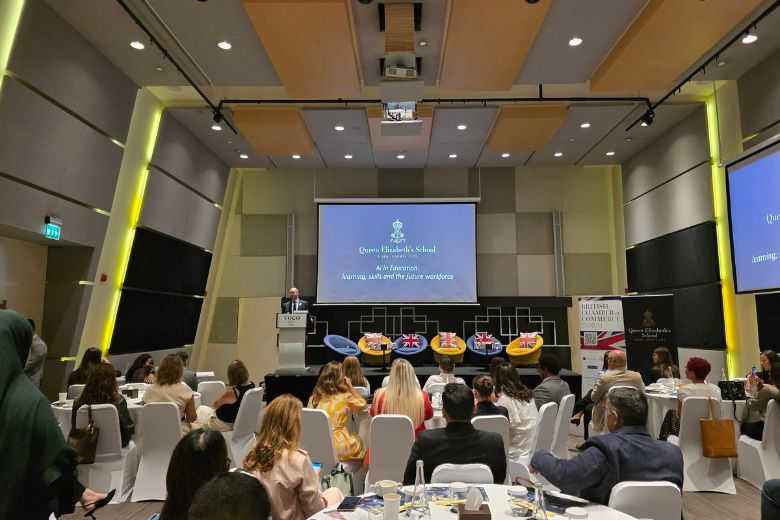
The Opportunity: Personalisation
For many in the room, AI’s greatest promise is personalised learning. Every child learns differently. Every teacher knows it, and every teacher has also spent a career bumping up against the same limit: thirty students, one adult, not enough hours to give each of them what they individually need. That gap is where the room’s optimism actually lived. Not in AI as a flashy add-on, but as the thing that might finally close it.
Clark pointed to AI’s potential to help schools solve one of education’s oldest problems, supporting more individualised learning experiences and identifying specific needs earlier and more accurately.
Astrid Kirkland, Founder of Kudos, reinforced the point, arguing that any AI solution entering a school should be judged against a single standard, “Personalisation.”
For SEND learners and students who need differentiated support in particular, AI could become a genuine lever for better outcomes and greater accessibility, rather than a one-size-fits-all add-on.
The Risk: Cognitive Debt
The panel was just as clear that AI carries real risk. One of the most discussed concepts of the morning was “cognitive debt”, the idea that leaning on AI too heavily can quietly erode the deep thinking and problem-solving that learning is supposed to build.
“Children need to be comfortably stuck.” – Dan Clark
That philosophy sits at the centre of how Queen Elizabeth’s School approaches learning. Resilience, expertise and confidence are built through challenge. If AI removes too much of the struggle, schools risk producing students who can produce the right answer without ever developing the thinking that should sit behind it.
Heather Harries, CEO of the Heather Harries Education Hub, echoed the concern, arguing that learning lives in the productive struggle and that there is no quick fix for it. The discomfort of not knowing something yet isn’t a flaw in the process, on her view, it’s the mechanism. Skip past it and you don’t arrive at the same understanding faster, you arrive somewhere shallower.
AI can accelerate access to information, but information was never really the bottleneck. Curiosity, perseverance, reflection, the slow accumulation of real understanding, none of that compresses just because the answer showed up sooner. Holding that balance, the panel agreed, will be one of education’s defining challenges over the next decade.
How Schools Are Responding
The conversation then turned practical. The consensus in the room was that schools should not try to resist AI. The more useful path is to embrace it thoughtfully, with clear guardrails.

Clark set out three priorities for schools navigating this shift
- Engage with AI honestly,
- Teach its ethical and critical use, and
- Protect space for independent thought.
“Discernment may become as important as technical competence.” – Dan Clark
Rather than banning AI tools outright, the panel’s view was that schools should be teaching students when, how and why to use them well. The institutions that get this right, several speakers noted, won’t be the ones that avoided AI. They’ll be the ones that understood it early.
The Role of Business
A significant part of the discussion focused on the link between classroom and workplace. Naz Panju, Director at British Canadian International Education Ltd, spoke to the shifting workforce landscape and what it means for schools preparing students today.
The future workforce is shaped long before recruitment, and schools and employers share that responsibility. As AI reshapes industries, employers are increasingly hiring for what technology can’t easily replicate: communication, adaptability, leadership, creativity, ethical judgement and collaboration. None of these traits show up fully formed on a CV. They’re built over years, in classrooms, long before a single interview takes place. The deeper question underneath all of it, the one the panel kept returning to, is what gets lost if schools don’t protect that.
“In this artificial world, how human can you be?” – Naz Panju, Director, British Canadian International Education Ltd
The panel was aligned on this point: schools and employers share responsibility for preparing the next generation, and education can’t be planned in isolation from where the workplace is heading.
Preparing Young People to Shape the Future
Clark closed this thread with a story rather than a statistic: Akshay, an Old Elizabethan who built his first business, the property platform Doorsteps, while still at school. He’s since gone on to back other student entrepreneurs through a cross-campus innovation incubator.
The point behind the story ran through the whole event. AI isn’t the destination. Human creativity, initiative and the willingness to build something new remain the differentiators, with or without the technology.
What Should Parents Do?
A parent in the audience asked one of the most practical questions of the morning: how should families support their children through an AI-driven shift in education?
The panel’s advice came down to a few clear actions:
- Look for ways to adopt AI rather than resist it, since resistance just delays a conversation children are already having without you
- Learn how the tools actually work, well enough to guide a child through them rather than hand down a blanket rule
- Know when to step in and say stop, rather than banning the technology outright
- When choosing a school, look closely at its approach to AI. The ones embracing it thoughtfully now are already ahead
Harries reminded the room that technology doesn’t replace the role of family, conversation and human guidance at home. And the panel returned more than once to a related point: AI should free up more time for human connection, not less. Mentoring, safeguarding and pastoral care need to stay fundamentally human-led, whatever else changes around them.
Reading Remains a Superpower
For an event built almost entirely around artificial intelligence, one of its clearest messages was refreshingly old-fashioned.
“Reading is still a superpower.” – Dan Clark
Whatever else changes, the ability to read deeply, think critically and work through complex ideas remains one of the strongest predictors of a student’s success, and nothing on the panel’s agenda suggested that was about to change.
Closing Thoughts
The discussion made one thing clear: AI is unlikely to replace great teachers, and it won’t replace learning itself. Its real value may lie elsewhere, in personalising learning, lifting administrative load off educators, and giving them back time for the relationships and conversations that matter most.
“I would like to think AI will free the pastoral care element in the classroom.” – Katy Keenan, CEO, British Chamber of Commerce Dubai

What the room kept arriving at, in different ways, was that none of this is really about the technology. It’s about whether schools, parents and employers are deliberate enough to use the time AI gives back for the things that actually need a human in the room.
About the Event
- Event: AI in Education: Learning, Skills and the Future Workforce
- Host: British Chamber of Commerce Dubai
- Founding Sponsor: Queen Elizabeth’s School Dubai Sports City
- Venue: voco Dubai
The Panel:
- Dan Clark, Principal, Queen Elizabeth’s School Dubai Sports City
- Naz Panju, Director, British Canadian International Education Ltd
- Astrid Kirkland, Founder, Kudos
- Heather Harries, CEO, Heather Harries Education Hub
- Aathira Rijin, Senior Business Intelligence Specialist, Presight AI, and alumna of The University of Manchester – Dubai
- Moderator: Katy Keenan, CEO, British Chamber of Commerce Dubai
For further information please visit