




































By uniting schools, students, and families, EdRuption and Digital Bridge are reframing digital wellbeing as a shared responsibility through the first research-driven, community-led screen-time reset.
Bio: Philippa Wraithmell is the CEO and Founder of EdRuption, a consultancy dedicated to empowering change through meaningful and sustainable digital transformation in education. An award-winning educator and author of The Digital Ecosystem, Philippa works globally with schools, trusts, governments, and families to embed digital strategy rooted in strong governance, inclusive pedagogy, innovation, and safeguarding. Her ethos is grounded in creating future-focused learning environments where technology serves as a tool to enhance wellbeing, foster equity, and build confident, digitally fluent communities. Through EdRuption and its parent-focused initiative, Digital Bridge, Philippa champions practical, values-led approaches to digital education that are both strategic and human-centred.
Why Digital Bridge?
When I stepped into my first role leading technology in a school over a decade ago, one truth stood out clearly: there was a profound disconnect between what students were experiencing in digital classrooms and what parents understood about that experience. I saw the growing divide, not just in access, but in understanding. Many parents were unaware of the pedagogical reasons behind classroom technology, or how platforms were selected based on curriculum needs. Others didn’t know that tools like screen time limits, app filters, and parental controls even existed, or how to use them.
Meanwhile, peer pressure, among children and parents, was escalating. “Everyone else is allowed to download that game” became the mantra. Parents who wanted to say no felt isolated. Others said yes, then regretted it.
It wasn’t just about safety online. It was about trust, clarity, and confidence in the role of technology in a child’s learning and wellbeing. So this became a passion project of mine, supporting parents to see what I could. Help to bridge the digital divide.
Since then, I’ve worked on a wide range of large-scale projects supporting both parents and EdTech companies, helping shape how we communicate these issues with families. Since EdRuption was formed in 2024, we have trialled countless formats, free workshops, parent handbooks, evening webinars, and repeatedly hit the same wall: lack of attendance, limited engagement, and, at times, no parents turning up at all. Even well-attended coffee mornings sometimes failed to spark the kind of behavioural change we hoped for. There was clearly a missing piece.
Research At The Heart
That reflection ultimately gave rise to the Digital Wellbeing Research Project, a six-week collaborative programme we developed through EdRuption and Digital Bridge. Because we believe that bringing the human element into everything we do is vital, but being research driven is the key to unlocking the needs of the people we work with. To give them most relevant and active support possible.
The aim was to go beyond awareness and into action.
- Could we support families in developing habits that stick?
- Could we help them see their own role, not just their child’s?
- Could we build a model of support that schools could adopt as part of their long-term digital strategies?
The answer, we now know, is yes.
Digital Bridge is built on the idea that digital transformation in schools cannot be successful without the support of families. At EdRuption, we work with schools to develop meaningful, sustainable digital strategies across governance, safeguarding, pedagogy, innovation and wellbeing. But over the years, we’ve seen again and again that if parents are not part of the journey, those strategies will not embed deeply or last long.
How Did It Work?
So we reimagined how to engage families. Not through one-off talks or technical lectures, but through shared experiences. We created workshops where parents could sit beside their children and build a digital pledge together. We facilitated conversations, not lectures. We normalised the struggles, recognised the emotional load, and reinforced the idea that small, collective changes could have a meaningful impact. Giving heartfelt examples of the real scenarios we ourselves have been through, and I will honestly say, sometimes even getting quite emotional ourselves, because being a parent is hard, but sharing that can help someone else get to where they need to be. Ultimately as parents we all want to do the best for our children.
In the project, we delivered activities that spoke to real-life struggles: how to create screen-free zones at home, how to discuss game use with curiosity not criticism, and how to set meaningful routines around bedtime and device storage. We guided families through digital habit-building with empathy and realism, not idealism. We are not looking for instagram lives, we want reality and connection.
We also helped school staff see themselves as digital role models. Many hadn’t paused to consider the message sent when adults use phones in corridors or respond to emails mid-conversation. In our staff CPD sessions, we asked leaders to reflect on their own habits and model boundaries openly. One of the most effective moments was when a school leader shared their own challenges switching off at night, and how setting downtime on their device became a simple but powerful act their children noticed.
The Digital Wellbeing Research Project Brought These Ideas to Life
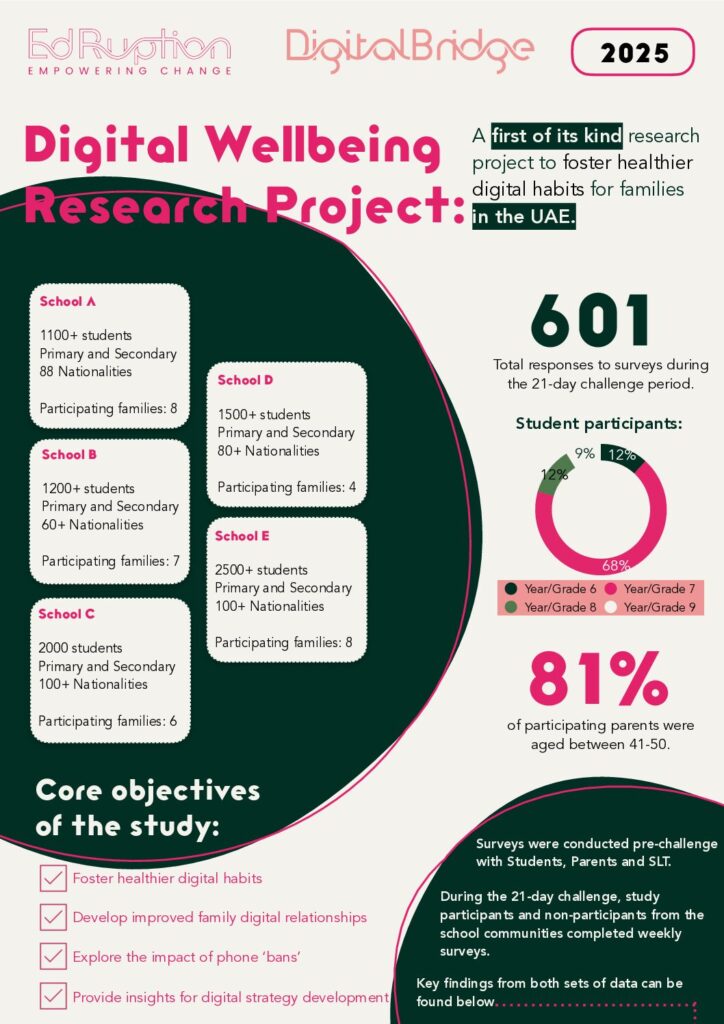
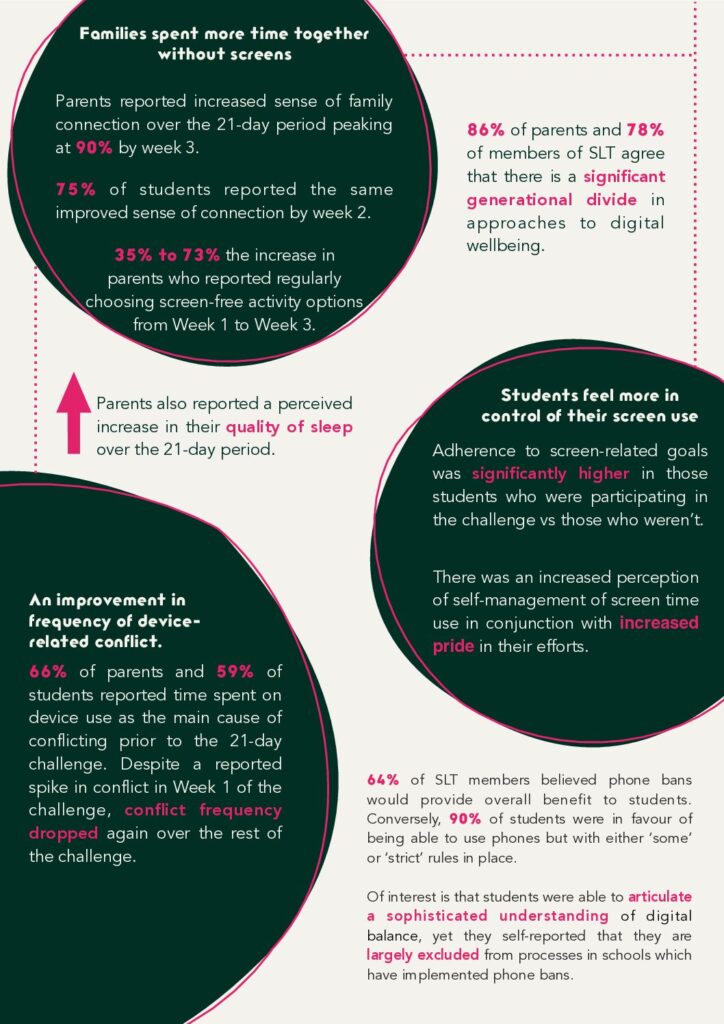
With the involvement of five international schools in Dubai and the support of student researchers from NYU Abu Dhabi, we explored the realities of family screen habits and school policies. Participating families took part in workshops, created personalised pledges, and then completed a 21-day digital wellbeing challenge. The results were compelling: parents reported better sleep, more screen-free family time, and stronger connections. Students reported increased pride in their ability to self-regulate. Even more importantly, both groups reflected on their habits with renewed clarity.
We also uncovered important tensions. School leaders often believed they were modelling good practice and maintaining effective policies, yet students and parents did not always share that view. Many students wanted to be part of the conversation but felt left out of decisions about school phone use. There was a consistent perception gap between intention and experience. That’s why the research didn’t just help families. It also gave schools a powerful lens to reflect on their own strategies.
What Makes Us Different?
We don’t advocate bans. We advocate balance.
We don’t shame. We support.
We don’t dictate values. We help families define their own.
This work is personal. And if I’m honest, part of the push came from observing the wider discourse too. Books like The Anxious Generation were being widely circulated among parent groups, but often only skimmed or shared in shocking soundbites. Social media was full of warnings and dramatic headlines, but lacked nuance. What was missing was honest reflection on adult behaviour. We had created a culture that criticised children’s digital habits while ignoring our own. We were asking children to disconnect while constantly refreshing our emails and notifications. If anything, EdRuption & Digital Bridge is built on us looking past perception and understanding the balanced approach.
Key findings included:
- 100% of student participants reported feeling proud of their screen management by Week 3.
- Parents experienced up to a 37% improvement in sleep quality.
- Families spent significantly more screen-free time together, with many reporting the deepest conversations they’d had in years.
- There was a generational divide between students (who wanted balance and inclusion) and SLTs (many of whom favoured bans).
At Digital Bridge, we wanted to shift that dynamic. We wanted to create space for parents to reflect without guilt, to set boundaries without shame, and to realise they were not alone in the struggle. Saying no is hard. Creating rules when your child is the only one who “can’t” have the app is harder. But we’ve learned that when families talk openly, when children are involved in setting limits, and when we all model better habits, change is possible.
One parent told us after the Vision & Values Workshop:
“We hadn’t spoken this honestly in years. I feel like I see my child again.”
I include myself in this. I’ve worked hard to create boundaries around my own device use, turning off notifications, setting downtime, separating work and home devices, but like everyone, I’m still prone to an aimless scroll, and that is ok, sometimes. I’ve taught students who admitted to spending over 24 hours on TikTok over a single weekend. That kind of usage isn’t just about apps or screens. It’s about emotional needs, habit loops, and our collective relationship with technology and relationships with adults who can confidently guide them.
What the Digital Wellbeing Research Project ultimately gave us was not just data, but direction. It showed us that change happens when people feel seen. When they feel safe to talk about what’s hard. When they have structure, support, and shared purpose.
Our wider Digital Bridge offering now includes parent webinars on pressures and parenting, induction sessions for Year 6 and Year 7 families, small-group support hosted in schools, digital awareness series for Sixth Formers, and even consultation for school leaders around digital policy alignment. We host whole-school digital challenges that engage entire communities and provide tailored coaching for staff on how to support families in their own digital routines.
We now know that this model works, and we are committed to growing it across more schools in the region and beyond.
Because at the heart of all of this is a belief that children deserve better, not just from their tech, but from us. They need connection, presence, and guidance. Up to the age of 18, and sometimes beyond. They spend unrestricted time outside of school from as young as three on their own personal device, we need to set standards from the moment we hand it over. That’s where our influence lives. That’s where their habits are formed. And that’s where we must do the work.
If we want the future of education and wellbeing to be balanced, thoughtful, and human, then the work must start with us. Not with bans or panic, but with empathy, understanding, and a willingness to make better choices, together.
To download the full report, click below:
About EdRuption & Digital Bridge
EdRuption & Digital Bridge is led by Founder and CEO Philippa Wraithmell with her dynamic team; Payal Patel our Director of Digital Wellbeing and Community Engagement works directly with schools to create bespoke workshops as well as our current workshops, all of which are co-created by our Senior education consultant team Dan Franklin(UAE) and Aarti Malani (UK).
Visit the Eruption and Digital Bridge websites below for more information:
Further Reading:
- Dubai Schools to Serve Healthier Meals Under New Municipality Guidelines
- Dubai School Waiting Lists Hit New Highs: What Parents Need to Know Now