































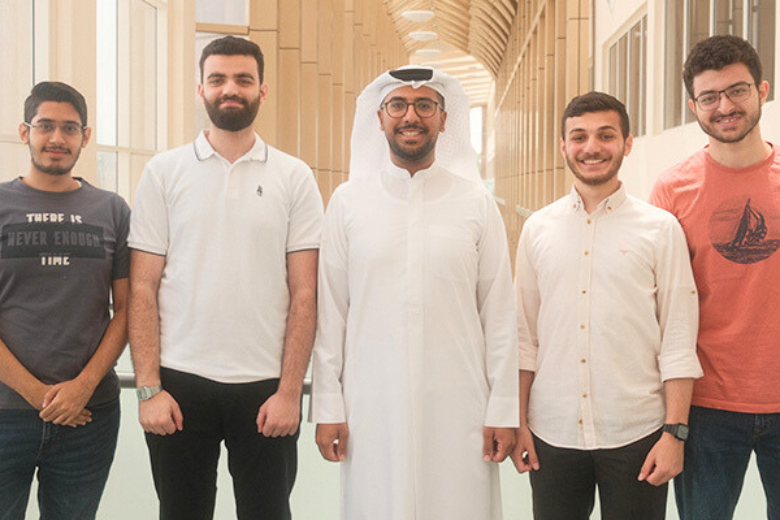
Students from the American University of Sharjah (AUS) have achieved global recognition with their groundbreaking project Shaheen, a drone-powered desert rescue system. The innovation, designed to detect missing individuals and transmit their exact coordinates to emergency teams, won second place at Dell Technologies’ 2024–2025 Envision the Future competition, which featured 259 projects from 14 countries across the Middle East, Turkey, and Africa.
Shaheen: Inspired by the Falcon
Named after the falcon celebrated in the UAE for its speed and precision, Shaheen mirrors these traits with its advanced search capabilities. When attached to a drone, the device scans vast desert areas with agility and accuracy, giving rescue teams critical minutes that can save lives.
The project was developed by computer engineering students Yousef Irshaid, Malik Hader, and Adham Elmosalamy, alongside computer science student Ahmad Alsaleh, under the supervision of Dr Mohamed Alhajri, Assistant Professor of Computer Science and Engineering. Earlier in May 2025, the AUS Department of Computer Science and Engineering recognised Shaheen as the top Senior Design Project of the Academic Year 2024–2025.
“Shaheen reflects the best of what our students can achieve when they combine innovation with purpose,” said Dr Alhajri. “Their system is efficient, practical, and capable of operating under the harshest conditions, reflecting the UAE’s vision of placing innovation and technology at the centre of growth and leadership.”
Building a Desert Search Database from Scratch
The team quickly realised that no existing desert image dataset was available for training their system. Undeterred, they created their own – the largest desert search-and-rescue image collection in the region. With the help of a drone pilot, they captured more than 7,500 real images across UAE deserts, varying clothing, poses, and movements to cover a wide range of scenarios. They also generated over 90,000 simulated images to strengthen training further.
This dataset enabled Shaheen to achieve 98 percent detection accuracy.
“That was the breakthrough moment,” recalled Irshaid. “It showed us Shaheen could move beyond a class project and truly save lives.”
Compact, Efficient, and Desert-Ready
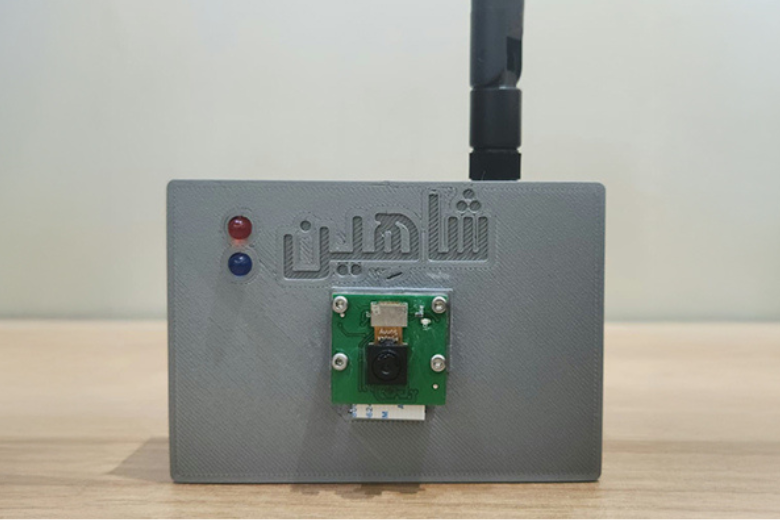
Engineered with precision, Shaheen is housed in a lightweight 3D-printed case and consumes less than one watt of power. The students also developed a new data transmission method, ensuring reliable image and coordinate delivery even under extreme desert conditions.
The team rigorously tested the system in both laboratory and real desert environments, pushing its limits against heat, terrain, and flight challenges.
“Every minute matters in a rescue,” said Alsaleh. “Knowing Shaheen could bring someone home safely kept us motivated.”
Next Steps for Shaheen
The team now plans to enhance Shaheen’s durability and suitability for desert operations while sharing their dataset and research to inspire further innovation. Full desert flight trials of the integrated system are also on the horizon.
“Our hope is for Shaheen to become a trusted tool for search and rescue teams across the UAE,” said Hader, “and eventually support rescue efforts in similar environments worldwide.”
Shaheen’s recognition underscores the spirit of innovation at AUS, where students and faculty collaborate on real-world solutions that extend far beyond the classroom.
Discover more about the AUS College of Engineering and its community of innovators at: