



































Families are now entering one of the busiest periods for school and nursery applications, with many parents carefully considering the best early education pathway for their children.
For first-time parents especially, waiting lists, registration deadlines, school tours, and admissions procedures can make the process feel overwhelming. One of the most common decisions families face is whether to place their child directly into a large school environment for FS1 or FS2, or to begin in a nursery or Montessori Early Childhood Centre.
While every child is different, many educators and child development specialists believe the early years should focus less on academic acceleration and more on building emotional, social, and cognitive foundations that support lifelong learning.
The Importance of the Early Years
In many education systems, formal schooling is not legally compulsory until around six years of age. This does not reduce the importance of early childhood education. In fact, early childhood is widely recognised as one of the most important developmental stages in human life.
Some of the world’s highest-performing education systems, including Finland, begin formal academics later than many other countries. Instead, they prioritise play, emotional security, creativity, movement, communication, independence, and a love of learning.
The goal is not to delay development, but to strengthen a child’s foundation before academic pressure begins.
Early childhood can be compared to the foundation of a house. Although unseen later in life, it supports the stability and strength of everything built above it. Confidence, communication skills, emotional security, resilience, and curiosity developed during these years often continue well into adulthood.
Benefits of Smaller Early Childhood Settings
Many families intentionally choose smaller, high-quality early childhood environments because young children often thrive when they are “big fish in a small pond.”
In smaller settings, children are more visible and more deeply understood by educators. Teachers are able to notice subtle changes in wellbeing, confidence, friendships, and learning styles because they spend meaningful time with each child.
Teacher-to-child ratios in many nurseries and Montessori settings are also often more favourable than in larger schools. This can contribute to calmer classrooms, more responsive interactions, and greater opportunities for children to question, communicate, explore, and build confidence at their own pace.
However, quality remains essential. Families are encouraged to look carefully at a setting’s philosophy, atmosphere, educator training, and the relationships between staff and children.
The Montessori Approach to Learning
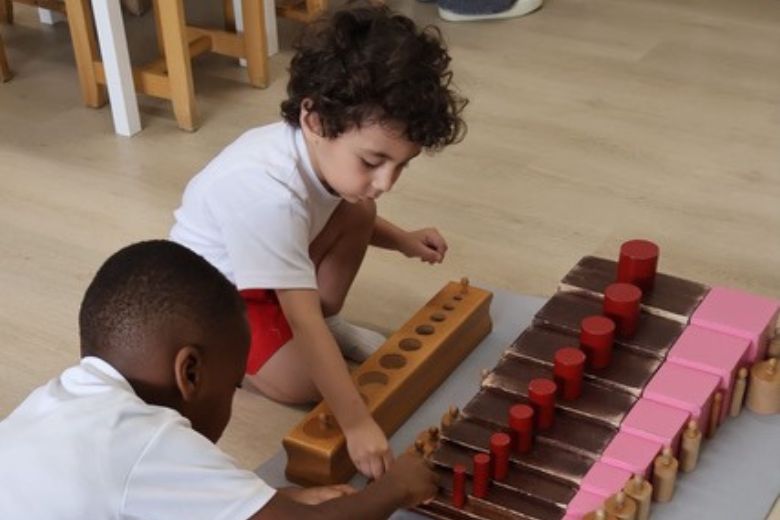
In some Montessori settings, screen-free learning environments are intentionally created to support child development through movement, conversation, sensory exploration, creativity, and hands-on experiences.
Montessori education offers an approach that differs from traditional academic models. Rather than relying heavily on pressure, comparison, rewards, or fear of failure, Montessori environments encourage children to explore, experiment, repeat activities, solve problems, and develop independence naturally.
This method aims to help children become confident and active learners rather than passive recipients of information.
Instead of focusing on a “pass or fail” mindset, Montessori education places value on curiosity, personal growth, effort, and understanding that learning is a continuous journey.
Allowing Children to Develop Confidence Naturally
Some children in highly structured school environments may appear organised and well directed, yet struggle to think independently once that structure is removed.
This can sometimes resemble opening the cage for a bird, only to discover that the bird does not yet know how to fly.
Parents today may also feel pressure from school marketing, admissions deadlines, and immediate registration demands. Families deserve the opportunity to visit settings, ask questions, observe classrooms, and make thoughtful decisions based on their child’s needs and family values rather than pressure or panic.
Early Childhood Is Not a Race
The early years should not be viewed as a competition. When children are given a calm, secure, and thoughtfully prepared foundation, they often transition into later schooling with greater resilience, confidence, emotional security, and a genuine love of learning.
For more details about Little Lands Nursery, please visit
Further Reading:
- Academic Excellence Across the Board, GEMS Students Deliver Another Year of Strong CBSE Results
- GEMS Education Announces Leadership Appointment for Flagship School